Poetry Therapy for Building Resilience Among Educators and Students
Professor Anna Romanova has developed a poetry therapy training program aimed at strengthening resilience.

Interview with the initiator of the "Education Without Stress" project, Anna Romanova, about the project to support mental health and create a safe psycho-emotional educational climate, which has united thousands of educators, pupils, students and parents throughout the country and abroad.
– Ms. Anna, the project team conducted a large-scale study of the psycho-emotional climate in Ukrainian schools, colleges and universities. What conclusions impressed you the most?
A.R.: I was most impressed by how vulnerable our teachers were. More than 86% of teachers felt a significant deterioration in their own psycho-emotional state after the start of a full-scale war. They talk about anxiety, exhaustion, sometimes even aggression caused by overload. School administration is also at risk, because they are the ones who stand "at the crossroads" of all conflicts – between parents, children and teachers. And at the same time, I am inspired by the fact that students demonstrate the greatest resilience; they can adapt more quickly, though they still need support. This is a good signal for the future, but it does not diminish our responsibility to them.
– If we talk about changes, what should Ukrainian education do to take these conclusions into account?
A.R.: The first thing is to reduce the level of stress at school. The school climate is not only about lessons, but it is also an atmosphere of trust, mutual respect, and security. If a child goes to school with a feeling of anxiety that he will be "bullied", ridiculed for something, no innovative technologies will help. Therefore, we need programs to support teachers, training in mediation skills, communication without conflicts, as well as real partnerships with parents.
– It is about cooperation with parents. How can it be established in schools?
A.R.: Very often, parents follow and care only about their child's grades. But the school is a living organism. Usually, parents have too much aggression and claims to teachers, little mutual respect, and sometimes there are not enough ethical codes and rules, and partnerships. I know an example when a teacher of the Ukrainian language started regular short meetings in a relaxed format of "gatherings with the teacher". This is only 20 minutes once a month, but it has removed half of the misunderstandings.
Another example is when the class teacher involves parents in resolving conflict situations not as "judges", but as partners. This is especially important in cases of bullying or discipline problems. Parents then do not "protect their child at all costs", but see the bigger picture.
– You mentioned bullying. What are the findings of the study here?
A.R.: Unfortunately, every fourth participant in the educational process faces bullying. We found out that most of them try to resolve conflicts on their own – without psychologists and social educators. Only 18% actually ask for help. This means that our school psychologists often remain "invisible". It is necessary to change the culture – to show children and adults that contacting a psychologist and a mediator is not a "weakness". On the contrary, it is a sign of maturity. More information should be provided to participants in the educational process about the services of a psychologist and social pedagogue, because sometimes they do not even know about their existence at school, college or university.
– And how can teachers reduce the number of conflicts in an educational institution?
A.R.: There are simple tools. For example, the technique of "emotional pause" – when, instead of an instant reaction to a provocation, the teacher first gives the class a few seconds to breathe. As for older students, it helps a lot to include them in decision-making: when children themselves discuss the rules of behavior or agree on how to react to being late, the level of conflicts is halved.
– Why is it so important to take care of the school climate even in times of war?
A.R.: Because it is he who forms a sense of security and trust. If a child feels protected at school, then even during an air raid or evacuation, they endure these trials more easily. I always say: The school climate is like soil. If it is toxic, nothing will germinate, not even the best seeds. And if it is alive and supportive, children open up, teachers do not burn out, and parents are willing to cooperate.
– And finally, you have launched a large-scale project "Education Without Stress". What is it and how to join?
A.R.: This is a large awareness campaign about "Stress-Free Education" with the support of the U.S. Embassy in Ukraine, which also includes a training course for all participants in the educational process: teachers, school administrations, social educators, psychologists, and even parents. The course is free, in a convenient online format, and upon completion, participants receive a certificate. There are practical tips, exercises on non-violent communication, stress reduction techniques for the class, Cases on inclusion, anti-bullying, and even "math anxiety," which often haunts children in front of tests.
Already 740 teachers have mastered the course and are applying their knowledge and skills in
practice. I sincerely invite everyone to take this free course. After all, changes in education do
not begin with ministerial orders, but with the atmosphere in a specific educational institution,
where every child, every teacher can feel safe.
Course link: https://surl.li/xcqupa
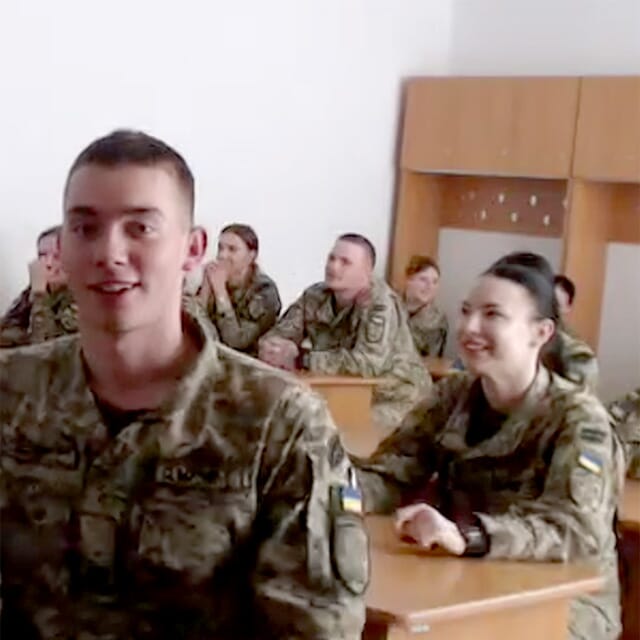
Professor Anna Romanova has developed a poetry therapy training program aimed at strengthening resilience.
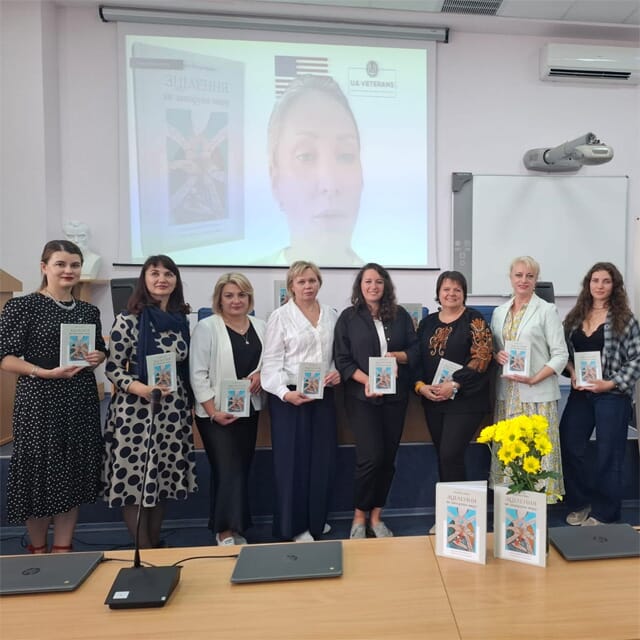
On September 17, an outstanding presentation of the book by the American author Angi Yoder-Maina

We invite you to a unique presentation of the book by the American author, experienced peacebuilder and director of the Institute for Resilience.

Combat veterans and individuals with disabilities due to the war can obtain professional training for free.